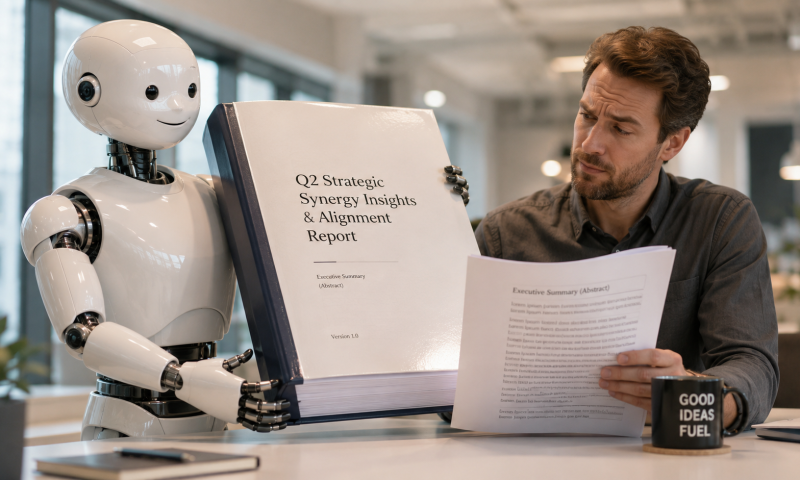

A Chief of Strategy at a mid-size financial services firm received a competitive analysis from an AI agent in April. Twelve pages: a segmentation grid, a competitor table, a risk assessment by category, three recommendations with timelines. It looked, if nobody had told you otherwise, like something a consulting firm had charged a fortune for. She read it over lunch and forwarded it to the CEO with one line. “AI pulled this together. Solid, I think.”
It was not solid. The lead competitor had changed its pricing three months earlier. Two board members the analysis marked as neutral were, to anyone who had sat in the February meeting, openly at war. The third recommendation, to expand into a particular segment, was something the company had piloted and shelved eight months before, a decision that lived in a Slack thread no model had ever seen. None of this was the machine’s fault; it worked with what it had. The problem was the “I think”.
Deciding is not approving
Something happens when AI hands you a well-formatted, well-evidenced, confident output. The mind slides into review instead of evaluation. You scan it, register the structure, find it plausible, and somewhere in there you approve it rather than decide on it. The difference does not show up until something goes wrong. Deciding means interrogating the recommendation against what you know, noticing what is missing, bringing the thing the model could never have: the relationship that is not in the data, the corridor conversation, the context that sits in no system anywhere. Approving means reading the summary and finding it convincing. Judgement, the very human capacity this moment is supposed to set free, needs a friction that polished output strips away.
The numbers behind the slide
Microsoft’s 2026 Work Trend Index, drawn from twenty thousand AI-using workers across ten countries, found 86% say they treat AI output as a starting point and stay responsible for the thinking.1 The same report found only 26% say their leadership is clearly aligned on AI. The highest performers, the ones the researchers call Frontier Professionals, are 43% more likely than everyone else to do some work deliberately without AI, to keep their own judgement in shape. Grant Thornton’s 2026 survey found 78% of executives lack real confidence they could pass an independent AI governance audit within ninety days.2 Most leaders are acting on AI-assisted decisions they could not fully explain if challenged. “AI informs, leaders decide” appears in nearly every governance deck this year. The slip is that “decide” has become “approve”, and approving asks far less of you.
The “who stands behind this” test
For any AI output that carries weight, a strategy, a stakeholder map, a risk assessment, a hiring brief, three questions before you act:
- Who here can explain it? Not summarise it. Explain the reasoning, name the assumptions, trace how the recommendation was reached. If the answer is no one, the output was received, not evaluated.
- What does this not know? Every recommendation has a boundary condition, the context it lacked, the event it missed. Name the boundary before you act on it.
- Who is accountable if this is wrong? A person’s name. If that is unclear, the judgement has not happened yet.
That is what putting human judgement in AI decisions looks like in practice. The test is for the calls that cost something when they go wrong; for routine, low-stakes output, taking the recommendation and moving is entirely sensible.
What to do this week
Take one AI-generated output from the last month, a report, an analysis, a recommendation, and run the three questions with whoever produced or used it. If nobody can explain the reasoning, name what the model could not see, or put their name against the outcome, the judgement did not happen; an output was received and treated as a conclusion. Then ask where else your team has been approving rather than deciding. That inventory is worth more than the next tool you bolt onto the stack.
There is a version of the next few years where leaders carry more influence than ever, precisely because they handed enough execution to the machine to have real time and energy for judgement. That version asks for the judgement to actually be used. The risk lives in the opposite direction, where decisions stop feeling like decisions and start feeling like approvals, and approvals ask so little of you that the slide is almost comfortable. Most organisations will not know they are on it until someone asks who stands behind the thing that just went wrong, and nobody in the meeting answers.
Sources:- Microsoft WorkLab, 2026 Work Trend Index, May 2026[↩]
- Grant Thornton, 2026 AI Impact Survey[↩]