
The project has gone wrong, the client is unhappy, and the call is full of people with excellent reasons it is not their fault. The data was AI-generated. The draft was AI-written. The research was AI-sourced, the timeline AI-suggested. Nobody lied. Nobody slacked. And somewhere between the prompt and the deliverable, not one person owned it.
This is the accountability gap, and it widens every month.
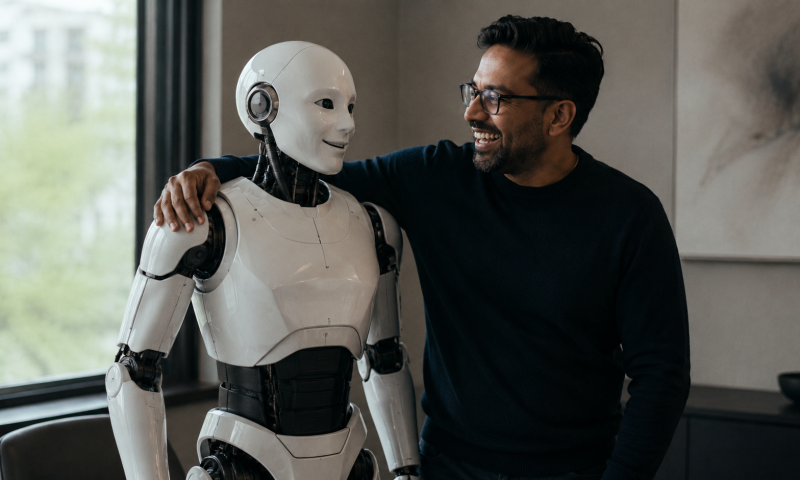
A study in Harvard Business Review in May 2026 found that when organisations dress AI up as a person, calling it a teammate, a colleague, a new hire, something measurable happens.1 Personal accountability drops. Escalation rises. Review quality falls. People grow less sure of their own role. Treating AI like a colleague hides three things a human brings for nothing: a stable sense of context across the day, the instinct to escalate when something feels off, and accountability that survives a bad outcome. An agent does none of the three. It will run a flawed plan with total confidence long after a person would have stopped and asked a question.
The confidence trap
There is a use of AI that earns its keep: you delegate what you are slower at, get it back faster, and spend your hours on the work only you can do. Ethan Mollick calls it the jagged frontier, where the machine beats most people at some tasks and humans stay well ahead on others.2 The people who do well will lean into their real strengths and consciously hand over the rest. But another use is spreading through organisations: AI as a shield. The work went wrong, the model gave bad data. The recommendation was poor, the AI suggested it. The human sits at the keyboard, present for the typing and absent from the outcome.
Setting the bar is owning it
Microsoft’s 2026 Work Trend Index, drawn from twenty thousand workers across ten countries, found that 86% of AI users treat its output as a starting point.3 The strongest of them, the research argues, will not be the ones who do more things faster. They will be the ones who set the intent, define the outcome and the quality bar, and design how the work moves between people and machines. Setting the quality bar is another way of saying owning the standard. Owning the standard is another way of saying willing to be judged by the result.
The skill is courage
The skill underneath all of this is courage, the ordinary daily kind: the nerve to put your name on something and mean it. In an age of AI execution that nerve is getting rare, and so it is getting valuable. It is the willingness to say I reviewed this, I am satisfied, I stand behind it, rather than the AI made it and I passed it on. Oversight is checking the AI did what you asked. Ownership is being the one who answers if it turns out that was the wrong thing to ask. Most organisations have not built the structures that force the difference, so human accountability in the age of AI slides into nobody’s job in particular.
The ownership stack
Before a real piece of AI-assisted work leaves the building, a recommendation, a report, a plan, run three questions. Not as a checklist. As a genuine pause.
- Could I explain what is in this without going back to the prompt? If you are leaning on the AI’s summary to tell you what the AI said, you have not reviewed it, you have forwarded it.
- If the outcome is wrong, am I the one who says so first? That instinct needs two things: knowing the context well enough to feel the wrongness, and the nerve to name it before you are asked.
- Would I put my own name on this in public? Not the team’s name, not the company’s. Yours. The question sharpens a review faster than any policy.
What to do this week
Take one piece of AI-assisted work that went out recently and ask who the accountable person was. Who would have fielded the complaint? Who could answer detailed questions about its content? If the answer is unclear, that is useful information about how your team is actually wired. Then have the conversation, not about AI policy but about ownership: for each significant AI-assisted deliverable, who is the named human on the hook. Not for running the prompt. For the outcome.
AI can execute. It can draft and analyse and arrange. What it cannot do is stand behind a thing, and that still takes a person, specifically a person willing to be the one who answers for it even when the machine did most of the work. That person is worth more now than two years ago. AI has not reduced the need for human judgement; it has made the humans who still exercise it far harder to find, and scarcity is its own kind of value.
Sources: